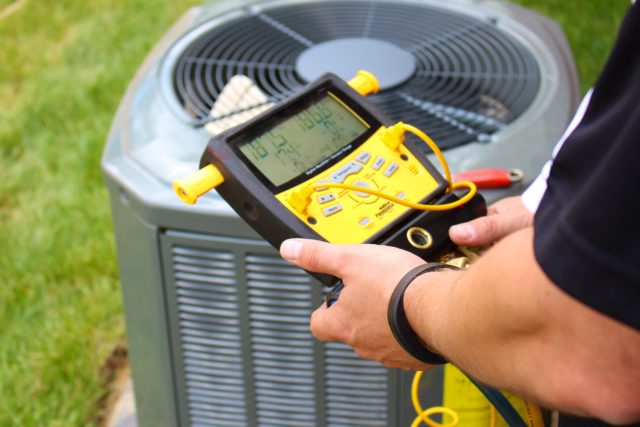
Most heat pump questions show up on the first cold night of the season. The vents feel lukewarm, the thermostat says “aux heat,” and steam is rising off the unit outside. Most of that is normal. Here’s what a working heat pump does in a Shelby winter, which signs point to a real problem, and when to call Shelby Heating & Air Conditioning for heat pump repair.
Why does my heat pump blow lukewarm air in winter?
A heat pump that blows lukewarm air in winter is usually working fine. A heat pump heats your home by moving warmth from the outdoor air indoors, and the air it delivers typically runs between about 90 and 110 degrees. That’s close to body temperature, so a hand held up to a register can read it as cool, especially if you’re used to a gas furnace’s hotter air. Judge the house, not the vent. If the thermostat reaches its setting and holds it, the system is doing its job. Lukewarm air becomes a problem when the house keeps falling behind the setting, when the air turns cold and stays cold, or when it never warms back up after a defrost cycle ends.
What does “aux heat” on the thermostat mean?
“Aux heat” means your heat pump’s backup heat is running alongside it. Usually that backup is a bank of electric heat strips in the indoor air handler. The thermostat turns it on automatically in three situations: on the coldest mornings, when the heat pump alone can’t keep up; during a defrost cycle; and when you raise the setting several degrees at once. All three are normal. Aux heat running steadily on a mild day in the 40s isn’t. At that temperature a healthy heat pump carries the house by itself, so steady aux heat points to low refrigerant, a defrost problem, or a thermostat set up wrong for the equipment. Strip heat costs far more to run, which our guide to heating repair costs in Shelby explains alongside the January power bill.
Aux heat vs. emergency heat: when should you use emergency heat?
Use emergency heat only when the outdoor unit has stopped working: it won’t run, it keeps tripping its breaker, or it’s encased in ice that defrost isn’t clearing. Emergency heat is a manual setting. It shuts the heat pump off completely and runs the backup heat alone, which keeps the house warm while you wait for a technician. Aux heat, by contrast, is automatic and runs with the heat pump. Switch back to Heat once the outdoor unit is fixed; left on, emergency heat keeps the strips doing all the work and the power bill shows it. And if the house won’t warm up even on emergency heat, the backup heat has a problem too. One customer put it this way in a review: the heat pump “would not go above 50 degrees, even with Emergency Heat turned on.” That calls for a technician the same day.
What does a heat pump defrost cycle look like?
A defrost cycle looks alarming the first time you see it. The outdoor fan stops, the unit hisses or whooshes, and a cloud of steam rises off it. That’s the heat pump briefly reversing to melt frost off its outdoor coil, which builds up on cold, damp mornings. A normal defrost lasts a few minutes, then the fan restarts and the steam stops. Indoors, the air may feel cooler for those minutes, and aux heat often comes on to cover the gap. Call us if a defrost runs past about 15 minutes, repeats back to back, or the coil stays covered in solid ice that keeps coming back.
How cold is too cold for a heat pump in Shelby?
A heat pump doesn’t shut off at a set outdoor temperature. It keeps pulling heat from the outside air well below freezing, with less output the colder it gets. Cleveland County’s winter design temperature, the cold mark that only about 1% of winter hours fall below, is 21°F. That puts Shelby in the middle ground: cold enough that aux heat should help on the coldest mornings, and mild enough that a correctly sized heat pump should carry the house on its own for most of the winter. So if your system leans on aux heat through ordinary 30s and 40s weather, look for a fault before blaming the weather.
Heat pump not heating: normal or time to call?
Most heat pump trouble shows up as one of these signs.
| What you notice | Usually normal when | Call us when |
|---|---|---|
| Lukewarm air from the vents | The house holds the thermostat setting | The house keeps falling behind, or the air stays cold after defrost ends |
| “Aux heat” on the thermostat | It’s in the 20s, the unit is defrosting, or you just raised the setting | It runs steadily on days in the 40s |
| Frost or ice on the outdoor unit | Light, even frost clears after each defrost | Thick ice builds up, covers the top, or stops the fan |
| Steam and a whoosh outside | It lasts a few minutes, then the fan restarts | Defrost runs past about 15 minutes or repeats back to back |
| Long run times | Long, steady cycles on the coldest days | It runs nonstop in mild weather, or the power bill jumps |
| Short on-off cycles | Not normal | It turns on and off every few minutes after you’ve changed the filter |
| Noises | A brief whoosh or click as defrost starts or ends | Grinding, squealing, rattling, or metal-on-metal sounds |
| Smells | A faint dusty smell the first time the heat runs each fall | A musty smell that lingers, or any hot electrical smell (turn the system off first) |
| Outdoor unit won’t run | Not normal | It stays dead, or the breaker trips again after one reset |
What to check before you call
Five minutes of checking sometimes saves a service call.
- Thermostat: set to Heat (not Emergency Heat unless the outdoor unit has failed), fan on Auto, and the setting a few degrees above room temperature.
- Filter: replace it if you can’t see light through it. A clogged filter makes every problem above worse.
- Breakers: the outdoor unit and the indoor air handler usually have separate breakers. Reset a tripped one once. If it trips again, leave it off and call.
- Outdoor unit: clear leaves and debris, keep 18 to 24 inches open around it, and make sure a gutter isn’t dripping onto the top. Don’t chip at ice on the coil; the fins bend easily.
Repair or replace an older heat pump?
Repair usually makes sense on a heat pump that has been maintained and is under about 10 to 12 years old. Past that age, or after a second major repair, price a replacement before spending more. On an older system, we’ll show you the repair cost next to what replacement would involve, and financing is available if replacement makes more sense. Our guide to when to repair or replace your heating system covers that decision in more detail.
Frequently Asked Questions
Is it OK to turn a heat pump down at night?
Small setbacks are fine. The catch is the morning: raising the setting several degrees at once can bring on aux heat, which can cost more than the setback saved. A setback of a couple of degrees, or a thermostat built for heat pumps that recovers gradually, avoids that.
Does Shelby Heating & Air Conditioning offer emergency heat pump repair?
Yes. Shelby Heating & Air Conditioning offers 24/7/365 emergency service and repairs heat pumps in Shelby and nearby towns including Cherryville, Grover, Forest City, and Rutherfordton. Service Agreement members pay no overtime charge on emergency after-hours calls.
Need heat pump repair in Shelby?
Call Shelby Heating & Air Conditioning at (704) 487-7877 or request service online. Tell us what the thermostat shows, whether you see ice outside, and when the problem started, so the technician comes prepared.
Related posts
 Air Conditioning
AC Not Cooling in Shelby, NC? What to Check Before You Call
 Air Conditioning